

TLDR: An ICASE PhD project at The University of Manchester (UK) funded by a generous scholarship drawing together ideas on anytime algorithms, simulation-based optimisation and combinatorial optimisation in order to tackle large-scale challenges in optimising energy transition technologies.
This project is open for UK/EU/International candidates
Industrial partner: SLB / Schlumberger Cambridge Research
Supervisors: Manuel López-Ibáñez (University of Manchester); Joshua Knowles (SLB / SCR)
Application deadline: 1st May 2027, but open for applications now, which may be considered on a first-come-first-serve basis.
Start date: September, 2027.

Read about the project (below) first.
Applications are sought from talented and motivated candidates with an academic background in at least one of these fields: Computer Science, Mathematics, Statistics, Operations Research, Data Science, Machine Learning, Industrial / Business Engineering or Business Analytics. Applicants must have a First or Upper Second Class Honours degree (or equivalent) and hold or expect to obtain a Masters level qualification with Distinction. English Language requirements (where required) are IELTS 7.0, TOEFL 623 (100 ibt), PTE 76.
Candidates should submit an online application for the PhD Business & Management, and indicate that they wish to be considered for the EPSRC/SLB INDUSTRIAL CASE PhD Studentship for “ExACt: Anytime Algorithms for Expensive, Combinatorial Problems”.
Apply here: https://www.alliancembs.manchester.ac.uk/study/phd/how-to-apply-for-a-phd/
For questions related to your application, contact: HUMS.doctoralacademy.admissions@manchester.ac.uk
Several of SLB major digital offerings, such as:
rely directly on the ability to solve combinatorial optimization problems efficiently, particularly as clients scale their products and operations. Improving cloud infrastructure and edge computing are part of the solution to this key issue, but by far the largest opportunity is in developing core algorithms that scale better on any hardware. Algorithmic speedups are typically much more profound improvements than hardware upgrades deliver.
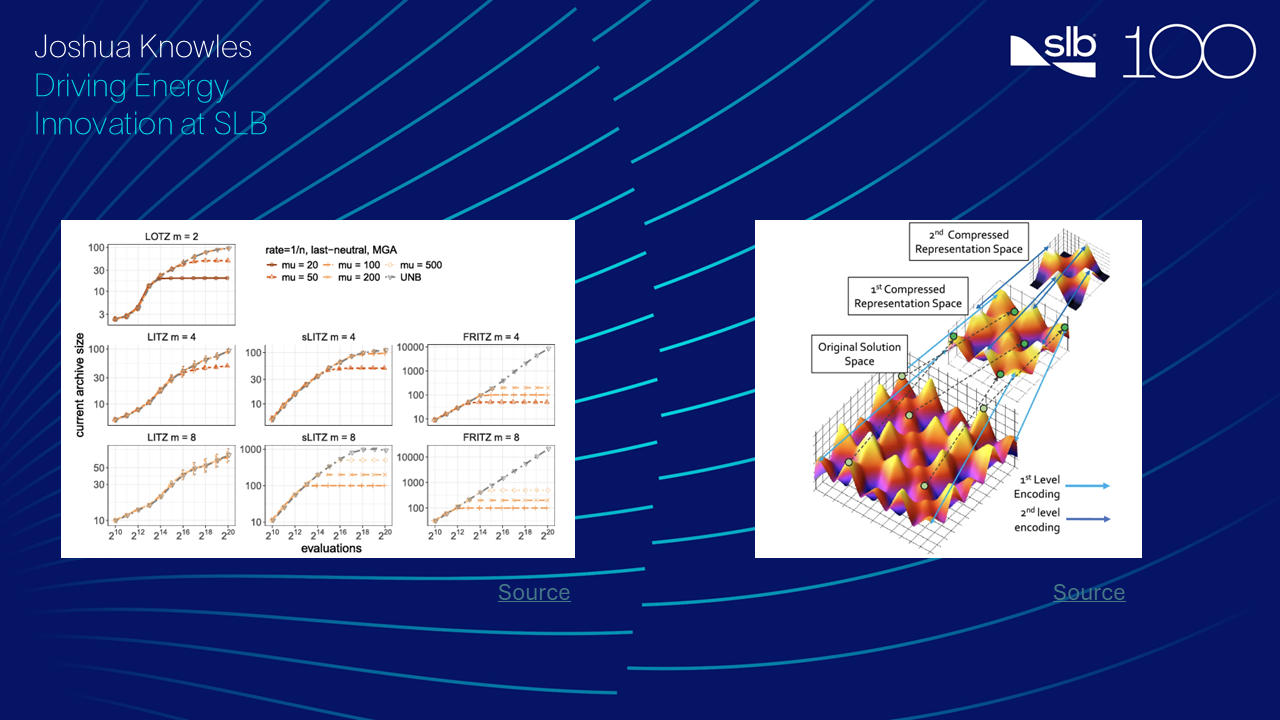
The problems addressed by the digital products noted above (and others) have a combination of difficulties that is still not adequately addressed by any known algorithm. They are expensive (meaning each call to the simulator or objective function used takes a long time to compute), have a combinatorial or mixed search domain (so are non-smooth, high-dimensional, and plagued by non-convex constraints), and are anytime-hard (meaning that while we may want to stop algorithms before they have finished, it is hard to design algorithms that when stopped early still give good performance, a.k.a., low regret).
While the challenge here is not solved, we believe that several lines of attack under recent development (see [1-8]) make it a worthwhile time to bring different ideas together to make a serious step forward on this important class of problems. An industrial PhD research project is the right basis for this.
Caldwell, J., Knowles, J., Thies, C., Kubacki, F., & Watson, R. Deep Optimisation: Transitioning the Scale of Evolutionary Search by Inducing and Searching in Deep Representations. SN Computer Science, 3(3), 1-26, 2022.
Chung, K. T., Lee, C. K. M., & Tsang, Y. P. Neural combinatorial optimization with reinforcement learning in industrial engineering: a survey. Artificial Intelligence Review, 58, 130, 2025.
Irurozki, E., & López-Ibáñez, M. Unbalanced Mallows Models for Optimizing Expensive Black-Box Permutation Problems. In Proceedings of GECCO 2021. ACM Press, New York, NY, 2021.
Kazemian, I., Yildirim, M., & Ramanan, P. Attention is All You Need to Optimize Wind Farm Operations and Maintenance. ePrints: 2410.24052, 2024.
Knowles, J., & Liefooghe, A. Anytime Benchmarking of Forty-Five PAES-25 Configurations on Multi- and Many-Objective Variants of Leading-Ones-Trailing-Zeros Functions. ACM Transactions on Evolutionary Learning and Optimization, doi: 10.1145/3787220, 2026.
López-Ibáñez, M., Chicano, F., & Gil-Merino, R. The Asteroid Routing Problem: A Benchmark for Expensive Black-Box Permutation Optimization. In J. L. Jiménez Laredo et al. (eds.), Applications of Evolutionary Computation, vol. 13224 of LNCS. Springer Nature, Switzerland, 2022.
López-Ibáñez, M., & Stützle, T. Automatically improving the anytime behaviour of optimisation algorithms. European Journal of Operational Research, 235(3), 569-582, 2024.
Lourenço, P., Costa, H., Branco, J., Garoche, P. L., Sadeghzadeh, A., Frey, J., …, & Preda, V. Verification and Validation of Optimisation-based Control Systems: Methods and Outcomes of VV4RTOS. Proceedings of ESA GNCICATT, 1-17, 2023.

SLB is the new name for Schlumberger (after rebranding in 2022). SLB is a global energy technology company employing 95,000 people with 160 nationalities, and operating in over 120 countries. SLB has been an international leader in supplying the technology for most of the main energy firms since the 1920s. It prides itself on its people, technology and performance. Nowadays, SLB is committed to bringing the tools needed for a global energy transition at scale. It is investing significantly in innovation of diverse solutions to energy production and storage, carbon capture and related new opportunities. It also sees digital solutions as a core growth area and enabling technology of the business.
Schlumberger Cambridge Research, located on one of the science parks at Cambridge University (near to the famous Cavendish Laboratory and Cambridge Computer Laboratory among others), is a subsidiary of SLB, and represents the pinnacle of SLB’s research capability. It employs around 70 scientists with expertise in all areas of energy development and digital technologies. Its purpose is to develop technologies in TRL1,2,3 (the most innovative) and with a 5-10 year development horizon.
Manuel López-Ibáñez is Full Professor (Chair) at the Alliance Manchester Business School, University of Manchester, UK. He has published more than 90 papers in international peer-reviewed journals and conferences. He is an ACM Senior Member and an IEEE Senior Member. He has supervised 10 PhD students to successful completion. He is an elected member of the ACM SIGEVO Executive Board and the Business Committee of GECCO (Genetic and Evolutionary Computation Conference), Editor-in-Chief of ACM Transactions on Evolutionary Learning and Optimization and Associate Editor of the IEEE Transactions on Evolutionary Computation journal. His research interests include the automatic configuration and design of optimisation algorithms including multi-objective and interactive optimisation algorithms for continuous, black-box, and combinatorial problems.
Joshua Knowles works full time in the Systems & Processes group at SLB / SCR, primarily developing machine learning and optimisation algorithms to support energy innovation. He is a senior fellow (former professor) of computer science at the University of Birmingham, an honorary professor at AMBS, University of Manchester, and he is an IEEE Fellow. He has supervised 17 PhDs and has a wealth of experience in industrial application of AI as well as fundamental work, especially in multi-objective optimisation. He co-created this project, following on from years of successful collaboration with Prof. López-Ibáñez, and will be involved in supervision at all stages. Joshua will also take an active role in mentoring you during your 3-month secondment in Cambridge.
If you are interested in this project, please contact Prof Manuel López-Ibáñez (manuel.lopez-ibanez@manchester.ac.uk) with an up-to-date CV including any publication profile.
For questions related to your application, contact Faculty of Humanities’ Doctoral Academy (HUMS.doctoralacademy.admissions@manchester.ac.uk)
See the ad in FindaPhD.
Last modified: 5 October 2026